Our Approach
To keep up with the pace of this fast-moving world, we need constant innovation. Telkom is committed to using our business assets to generate shared value for our stakeholders.
This is an extension of our purpose to “seamlessly connect people to a better life”.
But this is only possible if we act as responsible stewards of our planet, people and prosperity through exemplary practice. Here is a snapshot of our approach to sustainability.


Operational efficiencies
In February 2019, the GSMA (Groupe Speciale Mobile Association) set an ambition on behalf of the ICT industry to reach net zero carbon emissions by 2050. Telkom is a member of GSMA and has developed targets to align with the ambitions of the GSMA. As part of the operational efficiencies focus area, we have committed to the following:
- Reach carbon neutrality by 2035
- Achieve net-zero emissions by 2040
Our Net-Zero Emissions Journey
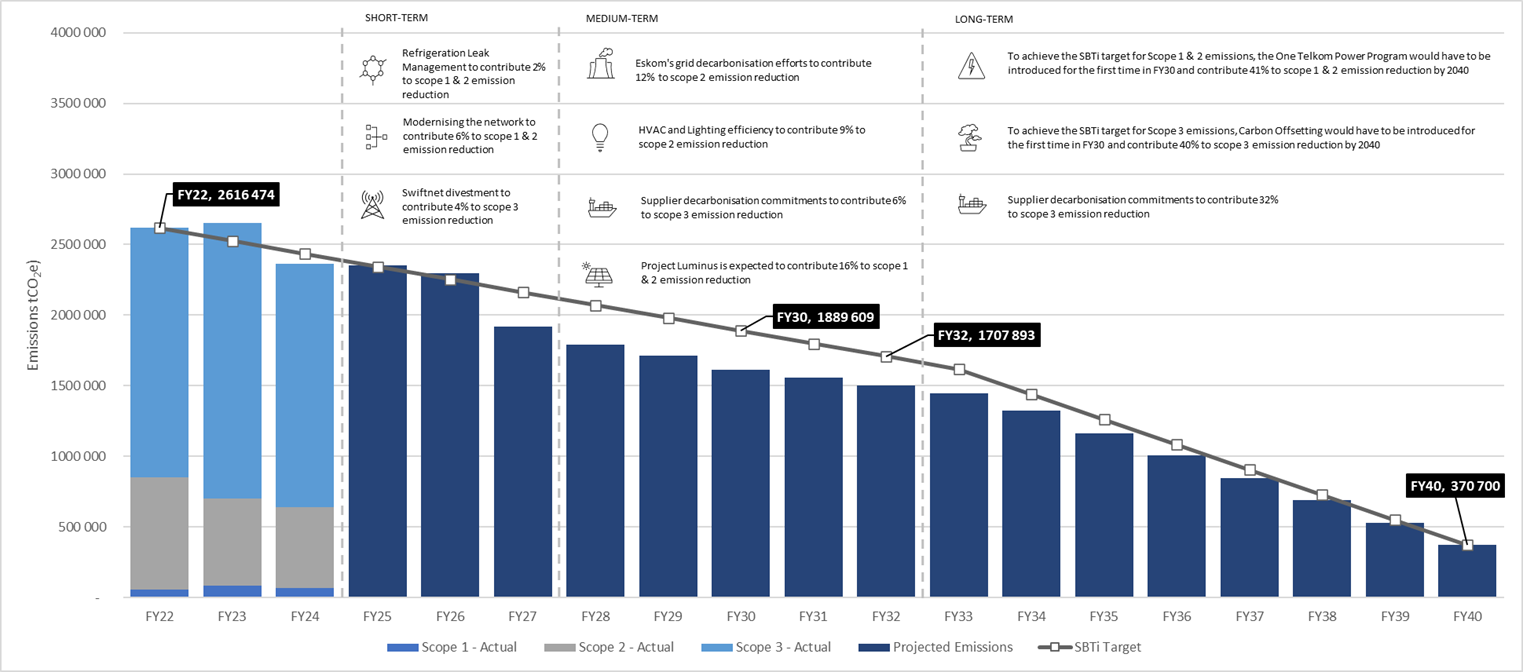
Telkom is firmly committed to achieving net-zero emissions by 2040, following a clear science-based pathway to reduce our carbon footprint across all emission scopes.
As of FY 2022, our total emissions stood at approximately 2.6 million tonnes of CO₂ equivalent. Since then, we have embarked on a progressive emissions reduction journey, guided by structured short, medium, and long-term targets.
In the years ahead, we will continue to reduce emissions year-on-year, with a key milestone set for FY2030, by which we aim to reduce emissions to below 1.9 million tCO₂e. Our long-term goal is a 90% reduction across all scopes by 2040, in alignment with the Science-Based Targets initiative (SBTi).
This journey reflects Telkom’s deep commitment to sustainable growth, responsible business practices, and a low-carbon future for South Africa. By embedding sustainability at the heart of our strategy, we are taking meaningful action today to shape a better tomorrow.
Our environmental performance
We have committed to reducing greenhouse gas (GHG) emissions year on year, with specific reduction targets. Using FY2022 as a base year, Scope 1 and 2 GHG emissions will be reduced by half by FY2033, and almost completely eliminated by FY2040.
The Science Based Targets initiative (SBTi) has acknowledged progress towards this commitment to keep global heating below catastrophic levels and reach net-zero by 2050 at the latest.
Read more about Telkom's Near-Term and Net-Zero targets, and the SBTI’s assessment thereof.
Environment
|
FY2022 baseline |
FY2024 actual |
FY2025 actual |
% change from FY2022 |
Status |
||
|---|---|---|---|---|---|---|---|
 Operational efficiencies Operational efficiencies |
|||||||
 Carbon neutral by 2035 (tCO₂e) Carbon neutral by 2035 (tCO₂e)
|
852,782 | 639,041 | 576,395 | -32% | |||
| 50% |
Reduction in fossil fuel consumption by 2030 (tCO₂e) |
55,466 | 85,100 | 66,119 | (23%) | ||
| 100% |
Renewable energy sources by 2035 (GWh) |
<1% | 13 320 | 33 284 | 2.5x up from FY2024 | ||
| Net-zero by 2040 | |||||||
| - |
Determine Scope 3 emissions | 1,764,216 | 1 724 460 | 1 713 336 | -2% | ||
| 75% | Reduction in waste to landfill by 2030 (tonnes) |
743 | 644 | 610 | -18% | ||
| 50% |
Reduction in portable water consumption by 2030 (kL) |
997,617 | 777 722 | 774 991 | -22% | ||
| 25% | Migration from R22 refrigerant gases in 2025 and 100% by 2035 (tonnes) |
38 | 34 | 31 | -18% | ||
 Digital planet Digital planet |
|||||||
| 70 000 | IoT devices deployed by 2025 | 15 220 | 73 679 | 95 170 | sixfold increase | ||

Legend |
|||||||
|---|---|---|---|---|---|---|---|
| Achieved | |||||||
| Making progress but long-term target not yet achieved | |||||||
| Not achieved, progress needs to be improved | |||||||
| No specific target set as part of the initial ESG strategy | |||||||
External moderate assurance on selected sustainability indicators. Please refer to the FY2025 Independent Assurance Report, available online
1. Business stewardship – this instills accountable and ethical operating practices, and encourages responsible technology usage, data privacy and security..
These pillars have found form in over 70 initiatives across all our business units, in our endeavour to create a lasting impact across our value chain and for the communities we serve.
Read more about our key strategic objectives Integrated Report FY 2025


Governance |
FY2022 baseline |
FY2024 performance |
FY2025 performance |
% change from FY2022 |
Status |
|---|---|---|---|---|---|
 Business stewardship Business stewardship |
|||||
| Culture of responsible technology and information use : | |||||
| Reduction in number of data breaches | 0 | 0 | 0 | 0 | |
| Promote fair and ethical practices towards our customers and within the Group | |||||
| Reduction in escalated customer complaints*** | 7 416 | 3 661 | 4 953 | -33% | |
| Decrease in whistle-blowing incidents reported from FY2023 | 152 | 121 | 71 | -41% | |
 Goal statements
Legend |
|||||||
|---|---|---|---|---|---|---|---|
| Achieved | |||||||
| Making progress but long-term target not yet achieved | |||||||
| Not achieved, progress needs to be improved | |||||||
| No specific target set as part of the initial ESG strategy | |||||||
*** Excludes complaints managed at the call centre, as these are too complex for reporting purposes.
1. Investing with purpose – this approach emphasises our social responsibility which finds form in leading localised CSI programmes and the development of SMMEs - while encouraging diversity, inclusion and equal opportunity.
2. Digital services – this highlights our commitment to deliver digital solutions that enable socio-economic upliftment.
3. Empowered communities – this showcases our determination to broaden access to affordable and inclusive digital connectivity, thereby enabling a better life for our customers.
Social Goal statements
FY2022 baseline
FY2024 actual
2025 actual
% change from FY2022
Status
Legend
* Lives impacted by job creation = the number of people employed at an SMME, which can either be actual or x4.1 average if the number of employed is unknown (Small Business Institute SA). To calculate lives impacted, apply an economic multiplier of x 3.3, representing the average number of people per household (Statistics South Africa).
** Digital literacy is the ability to use technology to connect with the world around us, to access opportunities and to use digital content to learn new skills/knowledge to contribute in a digitally connected society (UNESCO, UNICEF, EU).